The discussion about tourism on Aruba is often reduced to the slogan ‘No More Hotels’. But nowadays, the debate is about much more than just new hotel rooms. In this four-part investigative series, Caribbean Network explores how Aruba grew into one of the most touristic destinations in the Caribbean region, which economic dependence was created as a result, which social consequences are now becoming visible, and which choices are on the table in the coming years.
Part 2: The success of paradise
Forty years after Aruba made tourism an economic pillar, the island is among the most tourism-dependent economies in the world. How vulnerable that dependence is, became visible during the Corona pandemic. When the borders closed and tourism virtually came to a halt, the Aruban economy was hit hard.
But how large has that dependence become by now? In 2025, Aruba received over 1.5 million stayover tourists. In addition, 970,803 cruise passengers docked at the port of Oranjestad that year. Together, that amounted to nearly 2.5 million tourist visits. Those visitors also brought billions along in spending.
The current visitor numbers show how large tourism has become by now. But to determine the economic meaning of that for Aruba, more numbers are needed. For this analysis, we take 2023 as an example, because the most complete and mutually comparable data are available for that year. Stayover tourists spent an estimated 4.7 billion florins on Aruba that year.
The Aruba Tourism Authority (ATA) identifies that revenue as the most important indicator for the sector’s economic performance, because it shows how much money stayover tourists spend collectively on the island. But that amount does not mean that Aruba actually earns 4.7 billion florins.
Part of that money leaves the economy again, because hotels, restaurants, and other businesses purchase products and services from abroad or transfer profits and payments to foreign companies. To understand what tourism truly adds to the Aruban economy, more is therefore needed than just visitor spending.

Welcome Plaza at the cruiseterminal in Oranjestad (Melissa Stamper)
Aruba’s CBS uses, among other things, the Tourism Satellite Account (TSA) for this, that calculates tourism’s direct contribution to the economy. For 2023, that contribution amounts to about 1.63 billion florins, or 24.3 percent of the gross domestic product.
In doing so, the TSA does not limit itself to hotels and restaurants. Expenses for transportation, recreation, retail, and other tourist services are also included, to the extent that they relate directly to the visitors’ stay. This way the TSA gives a broader picture of the direct economic contribution of tourism instead of just the revenue of the hotel sector.
How that works in practice, is visible in the accommodation and food services sector. This sector produced over 3.25 billion florins in goods and services in 2023. After deducting the goods and services that were needed for that, about 1.28 billion florins in gross added value remained.
The economic importance of tourism is also reflected in the labor market. Aruba employed 54,523 people in 2023, according to the CBS labor force survey. Hotels and restaurants were the most common industry: converted, more than one in five employees worked in this sector.

Restaurant Smokey Joe’s near Palm Beach (Melissa Stamper)
The government benefits too
The economic growth is also reflected in public finances. The Central Bank of Aruba (CBA) and the Board of Aruba Financial Supervision (CAft) note that the strong performance of the tourism sector has contributed to higher tax revenues and an improvement in the budget position.
In addition, tourism directly yields revenue for the government through various levies. According to an overview by the Advisory Council, 64.6 million florins in tourist tax and 14.4 million florins in environmental tax for hotels were collected in 2023, among other things. Since 2023, the tourist tax is directly divided between the country, the Aruba Tourism Authority (ATA), and the Tourism Product Enhancement Fund (TPEF).
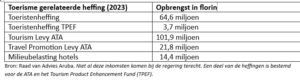
(Translation:
Tourism-related levy (2023) – Revenue in florin
Tourist tax: 64.6 million
Tourist tax TPEF: 3.7 million
Tourism Levy ATA: 101.9 million
Travel Promotion Levy ATA: 21.8 million
Environmental tax hotels: 14.4 million)
Source: Advisory Council Aruba. Not all these revenues end up with the government. A portion of the levies is intended for the Aruba Tourism Authority (ATA) and the Tourism Product Enhancement Fund (TPEF).
Set against those revenues are also tax arrangements for the sector. For instance, an exemption from the general turnover tax (BBO/BAZV/BAVP) applies to the rental of hotel rooms and other tourist accommodations, if tourist tax is paid on them. That is evident from the Tax Department of Aruba’s information (DIMP). The exemption does not apply to other hotel activities, such as restaurants, bars, or spas, to which turnover tax does apply. How much tax revenue the government misses out on because of this, or how much the sector benefits from this annually, is not clear from public figures.
Not all revenues stay in Aruba
Still, not all the money that tourists spend stays in Aruba. The CBA points out that the growth of tourism is also accompanied by higher imports and outgoing income streams to foreign countries. How large the share of, for example, dividend payouts from foreign hotel chains is, is not clear from the available figures. However, the import dependence is clearly visible: in 2023, excluding crude oil, Aruba imported over 2.76 billion florins in goods. Over 680 million florins thereof consisted of food products.
Outgoing income streams are also visible on the balance of payments. In 2024, the deficit on the ‘primary income’ item, which includes among other things interest and dividend payments, amounted to over 405 million florins. The CBA does not specify which portion of that is connected to the tourism sector.
Growth in 2025 and 2026
The most recent figures show that the growth of the tourism sector has continued. Aruba received over 1.5 million stayover tourists in 2025, accounting for over 5.55 billion florins in tourism credits. Those revenues were 6.5 percent higher than the year before. But the average daily spending per tourist rose slightly, from about 532 to 539 florins.
Tourism revenues thus rose at virtually the same pace as the number of stayover tourists. In other words: tourism revenues are growing mainly because more people visit Aruba, not because the average tourist spends much more.

Arrival hall Reina Beatrix Airport in 2026 (Melissa Stamper)
That growth continues in 2026 as well. In the first half of the year, Aruba received 845,501 stayover tourists and 551,168 cruise passengers. Together, the island thus welcomed nearly 1.4 million visitors in just six months. The number of overnight stays by stayover tourists grew in the same period by 11.2 percent to over 5.7 million.
The figures show that tourism continues to grow economically. But that growth also raises new questions. An increasingly larger share of visitors stays outside the traditional hotel sector. What that means for the housing market, the living environment, and the available space in Aruba, is central to the next part of this series.
This publication was realized with the support of the Special Journalistic Projects Fund.