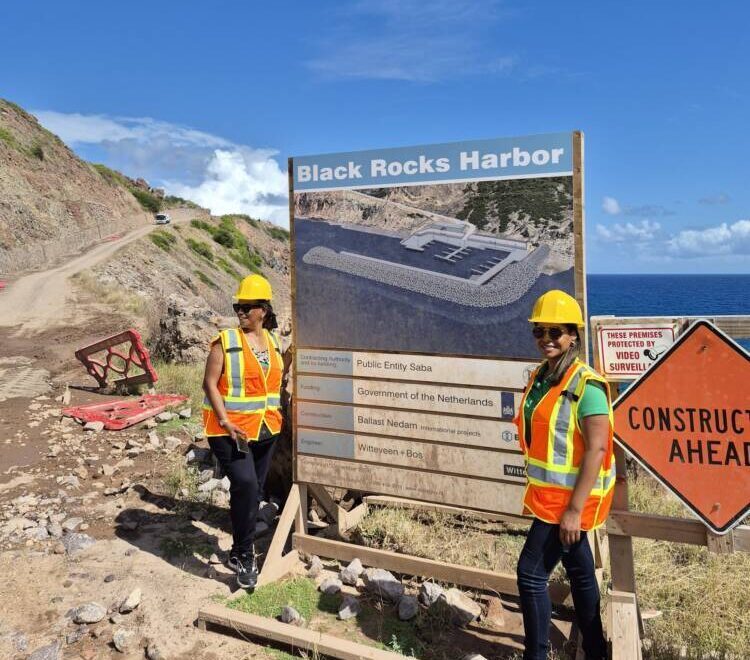
Caribbean Network was given the opportunity to tour the ongoing developments at the much-anticipated, more hurricane-resistant Black Rocks Harbor. Peter Biemond, Project Director on behalf of the Public Entity Saba for the Black Rocks Harbor Project, explained that while significant work remains, steady progress is being made. The breakwater is expected to be completed by the end of this year, with key hardware and infrastructure, such as the jetties and additional marina infrastructure required to support services at the harbor, scheduled to be finished before the 2027 hurricane season. Development of buildings and landslide facilities will begin thereafter.
The project, funded by the Ministry of Infrastructure and Water Management (I&W, Ministerie van Infrastructuur en Waterstaat ) and the Ministry of the Interior and Kingdom Relations (BZK, Ministerie van Binnenlandse Zaken en Koninkrijksrelaties ), is currently prioritizing construction of the breakwater, which will protect the new port from hurricane swells.
The goal of Black Rocks Harbor is to become the island’s primary port of entry for visitors. The marina will be able to accommodate daily ferry services, small vessels, luxury yachts, dive boats, local fishing boats, and the rescue vessel. The harbor’s infrastructure will also include improved facilities for customs and immigration clearance. At the same time, the new harbor will be capable of accommodating cargo vessels as back up if conditions make docking at the existing Fort Bay Harbor difficult.
According to Biemond, the surrounding area could gradually be developed to include restaurants, souvenir shops, storage facilities for dive operators, and eventually real estate. “Instead of making everything very concrete, we are working with the architect on a stepped design approach so there are more shade and greenery,” he said. “It should also create an inviting environment for visitors arriving by ferry or yacht from the neighboring islands and for people from Saba during the weekends.”
Involvement of regional and local contractors
The ability of the Dutch Caribbean islands to support one another’s initiatives is being demonstrated through the production of the specialized 35-ton protective x-blocs, which are being manufactured on St. Eustatius and transported to Saba for the Black Rocks Harbor project. To facilitate this effort, a plot of land on St. Eustatius was cleared bycontractor Ballast Nedam International Projects (BNIP), specifically for the production and staging of approximately 1,500 X-blocks. These engineered concrete blocks are used in coastal defense, breakwaters, and shore protection.
While the contractor has imported several pieces of specialized heavy equipment from the Netherlands via St. Maarten for the project, local expertise is also playing an important role. Local subcontractors are actively involved in carrying out various aspects of the work. Truck drivers from Saba are transporting rocks supplied by the local manufacturer Big Rock Engineering and transporting raw materials recovered from the recent demolition of the old school gym to be reused as backfill and to help construct the access roadway to the new harbor facilities.
This collaboration between regional partners and local contractors highlights the project’s broader impact, supporting both infrastructure development and economic participation across the Dutch Caribbean.
The Crew
The workforce behind this major undertaking is made up of a diverse group of professionals from across the world, including workers from Bonaire, St. Lucia, Suriname, Turkey, India, Indonesia, Sri Lanka, Africa and the Netherlands, among others. To accommodate the more than 100 workers expected to be involved in the project, an impressive campsite has been constructed near the worksite. Each worker has their own bedroom, while bathroom and shower facilities are shared. Supervisors are housed in separate living quarters that also include small office spaces where they can carry out daily administrative tasks.
The camp has been designed to be largely self-sufficient. It includes its own transformer station to supply electricity and produces its own water through a reverse osmosis desalination system that draws water from the nearby ocean. Additional amenities for the crew include a gym, cafeteria, and communal lounge areas where workers can relax during their downtime. The camp is nearing completion, with approximately 30 workers currently residing on-site.
Safety remains a top priority on the project. The site tour began with a comprehensive safety briefing outlining the expectations for all visitors and workers alike, including the mandatory use of personal protective equipment (PPE) at all times. A designated nurse is also expected to join the team soon to further support health and safety operations at the worksite.
Environmental Concerns
Environmental organizations on Saba had raised concerns about the potential impact of the Black Rocks Harbor development on the island’s renowned coral reefs along the shoreline. According to Biemond, extensive measures were taken to protect the coral during the early stages of the project. More than 1,000 pieces of coral were carefully relocated, and ongoing monitoring indicates a survival rate of approximately 90 percent.
“They more or less secure the coral in the outplant location to the seabed using a type of cement epoxy,” Biemond explained. “After that, we can see that it rapidly begins growing again.” In addition to relocating the coral, the project team is continuously monitoring the turbidity of the water during construction activities to ensure that operations do not cause excessive disturbance to water quality. These measures are intended to minimize environmental impact while work on the new harbor continues.
At the conclusion of the project, most of the temporary structures, including the workers’ campsite, will be dismantled in accordance with the project agreement. The cleared property may later be considered for other forms of development.