The discussion about tourism on Aruba is often reduced to the slogan ‘No More Hotels.’ But nowadays, the debate is about much more than just new hotel rooms. In this four-part investigative series, the Caribbean Network explores how Aruba grew into one of the most touristic destinations in the Caribbean, which economic dependency that resulted in, which social consequences are now becoming visible, and which choices will be available in the coming years.
Part 1: The Tourism Promise
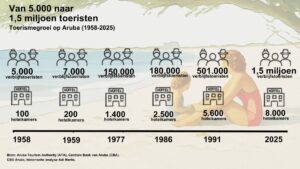
 Aruba has about 125,000 residents – on paper. But calculations by the Central Bureau of Statistics Aruba (CBS), add nearly 31,000 tourists on an average day in 2025, based on the Tourism Equivalent Population. Over the entire year, Aruba welcomed over 1.5 million stay-over tourists and nearly a million (970,803) cruise passengers. Thus, on an average day, about one in five people in Aruba were visitors. How did Aruba get to this point?
After the Lago
Halfway through the 1980s, Aruba found itself at an economic turning point. Since 1924, the Lago Oil & Transport Company, owned by the American oil company Exxon, had determined the economic development of the island. The oil refinery provided work for thousands of Arubans and was the beating heart of the economy on the island for decades.
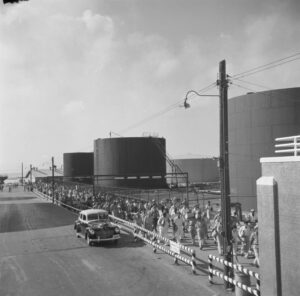
Staff leaving the Lago oil refinery in San Nicolas, Aruba. (Photo by Willem van de Poll, 1947, National Archives)
But nine months before Aruba obtained its Status Aparte on January 1, 1986, the Lago refinery closed its doors. Historian Adi Martis tells Caribbean Network in an interview that the economic impact was enormous. Approximately eight percent of the working population worked at the oil refinery. Around 1,300 people lost their jobs directly, while another 6,000 to 7,000 jobs were indirectly dependent on Lago. Moreover, the company represented about thirty percent of Aruba’s gross domestic product (GDP) and paid a similar share of income tax.
Tourism sector expansion
“The economic situation seemed disastrous,” says Martis. Just when Aruba gained more administrative responsibility, a major part of the economy collapsed. Still, the first few years turned out differently than many economists had expected, he states. The brand-new prime minister of the Country of Aruba, Henny Eman (AVP), did not focus solely on budget cuts and fiscal measures, but chose at the same time to rapidly expand the tourism sector. Between 1986 and 1991, the number of hotel rooms doubled. According to economist and urban planner Sam Cole, approximately ten new hotels with around 4,000 additional rooms were built between 1985 and 2000.
Meanwhile, the population also grew rapidly. CBS figures show that annual population growth fluctuated between 4.5 and 8.3 percent between 1990 and 1993. According to Cole, that growth was linked to the demand for workers for the rapidly expanding tourism sector.
Limits to Growth
But the discussion about the limits of that growth began much earlier. As early as 1977, the Aruban government emphasized that tourism development could not continue indefinitely. Minutes show that Commissioner of Tourism Caspar Boekhoudt (MEP) announced in the Island Council that the Executive Council had in principle decided to impose a moratorium on additional hotel rooms.
He pointed to the ratio between the number of tourists and hotel rooms, the capacity of the infrastructure, and the additional employees that new hotels would require. At the same time, he stated that Aruba had not yet reached its optimal growth point. According to him, further expansion should be gradual and supported by research. In addition, he advocated for economic diversification, including the development of new industries and the free zone.
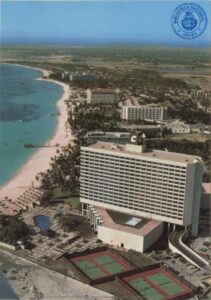
The Concorde Hotel in 1986. The hotel was later named Wyndham Aruba Resort and is currently Hotel Riu Palace Antillas. (BNA Postcard Collection)
The idea to limit the growth of the hotel sector continued resurfacing in tourism policy afterwards, states Martis. For instance, in 1988, Eman announced that the government was investigating whether a temporary construction freeze would be necessary after the doubling of hotel capacity. Later that year, his cabinet decided to introduce a moratorium and to suspend tax incentives for hotels, timeshares, and restaurants.
A year later, the government of Prime Minister Nelson Oduber (MEP) wrote in the first issue of Noticiero Aruba that a healthy economy could not rely on a single pillar and that, alongside the further development of the tourism product, a moratorium on the construction of new hotels was necessary. The Minister of Economic Affairs and Tourism at the time, Eddy Briesen (MEP), also declared at the end of 1990 that Aruba had already announced a moratorium a year earlier. A 1992 court case too revealed that a construction freeze would have been in effect since June 1988.
Archival documents and official policy papers show that for years, successive Aruban governments used the moratorium as a policy tool. However, a legal basis was lacking. So the Dutch government wrote in 1997 that Aruba had promised to introduce a statutory moratorium, but that this promise had not yet been fulfilled – while in fact the moratorium did happen to be in force.
It was not until 2018 that a moratorium was legally anchored for the first time via a preliminary planning decision based on the Spatial Development Ordinance (Landsverordening Ruimtelijke Ontwikkeling). That regulation too left room for exceptions, including for developments in San Nicolas and later for specific projects in, among other locations, Oranjestad.
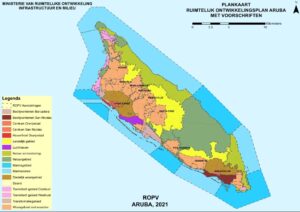
ROPV map showing the tourism zone in pink.
Making room for tourism
Aruba was also organized differently, to accommodate the growth of tourism. In the early 1980s, the government worked on plans that determined where hotels could be built and how the west coast should develop as a tourist area. Together with economist and urban planner Sam Cole, work was done on ‘Planning an Independent Future’, a development vision in which tourism was designated as one of the main pillars for the future economy. That vision was elaborated in the 1981 ‘Physical Development Plan’ and the 1983 ‘Aruba Tourism Development Plan’.
At the same time, Cole warned that a small island economy remains vulnerable when it becomes too dependent on a few economic sectors. He therefore advocated for economic diversification and emphasized that further growth had to proceed according to planning.
The government designated the west coast as the area where further growth of tourism had to take place. Along the coast, a tourist corridor emerged from Oranjestad to California Point, where new hotels, infrastructure, and recreational facilities were concentrated. At the same time, according to the plan, open space had to be preserved and public access to the beaches guaranteed.
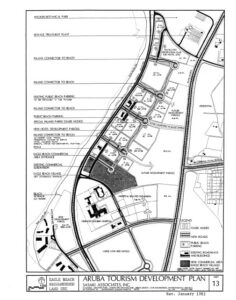
The development plans visualized. (Aruba Tourism Development Plan 1983)
To make room for the new hotel zone, the L.G. Smith Boulevard was moved inland on parts of the west coast. This created nineteen new plots directly on the sea that were made suitable for large-scale hotel development. The construction of hotels was accompanied by investments in roads, water mains, and sewage facilities.
Palm Beach versus Eagle Beach
The beaches Palm Beach and Eagle Beach were consciously given different character vibes as a result. Palm Beach was designated for high-rise buildings and large-scale resorts, the so-called high-rise hotels, while Eagle Beach was intended to retain its small-scale character with low-rise buildings (low-rise hotels). That choice extended beyond different hotel types. For Palm Beach, the plan envisioned a more urban character with high-rises along a wide boulevard, while Eagle Beach was meant to preserve a lower building density, more greenery, and multiple public access routes to the beach.
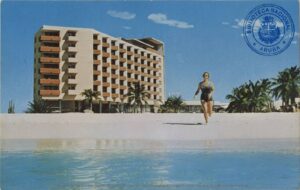
Aruba’s first luxury hotel, the Aruba Caribbean Hotel on Palm Beach, in 1962. Today this is the Hilton Aruba Caribbean Resort & Casino. (BNA Postcard Collection)
Beach Had to Remain Public
From the design of the Tourism Corridor, public access to the coast was a starting principle. Therefore, more public connections from the boulevard to the beach were drawn on the design maps.
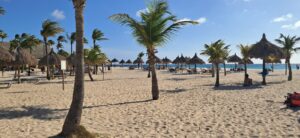
Manchebo Beach. (Photo: Melissa Stamper)
That guiding principle was later also established in guidelines for the design and use of the beaches. The Spatial Design Guideline Beaches (Richtlijn Ruimtelijke Inrichting Stranden, RRIS) established, among other things, public accessways, clear strips along the waterline, and rules for beach amenities. What began as a response to the economic consequences of the closure of Lago, grew in the following years into Aruba’s most important economic pillar. At the same time, the question kept resurfacing as to how far that growth could continue.
The tourism course that Aruba set in the 1980s determined the island’s economic development for a long time. What that choice brought Aruba and how dependent the economy has since become on tourism, is the central focus of the second part of this series.
This publication was realized with the support of the Special Journalistic Projects Fund.