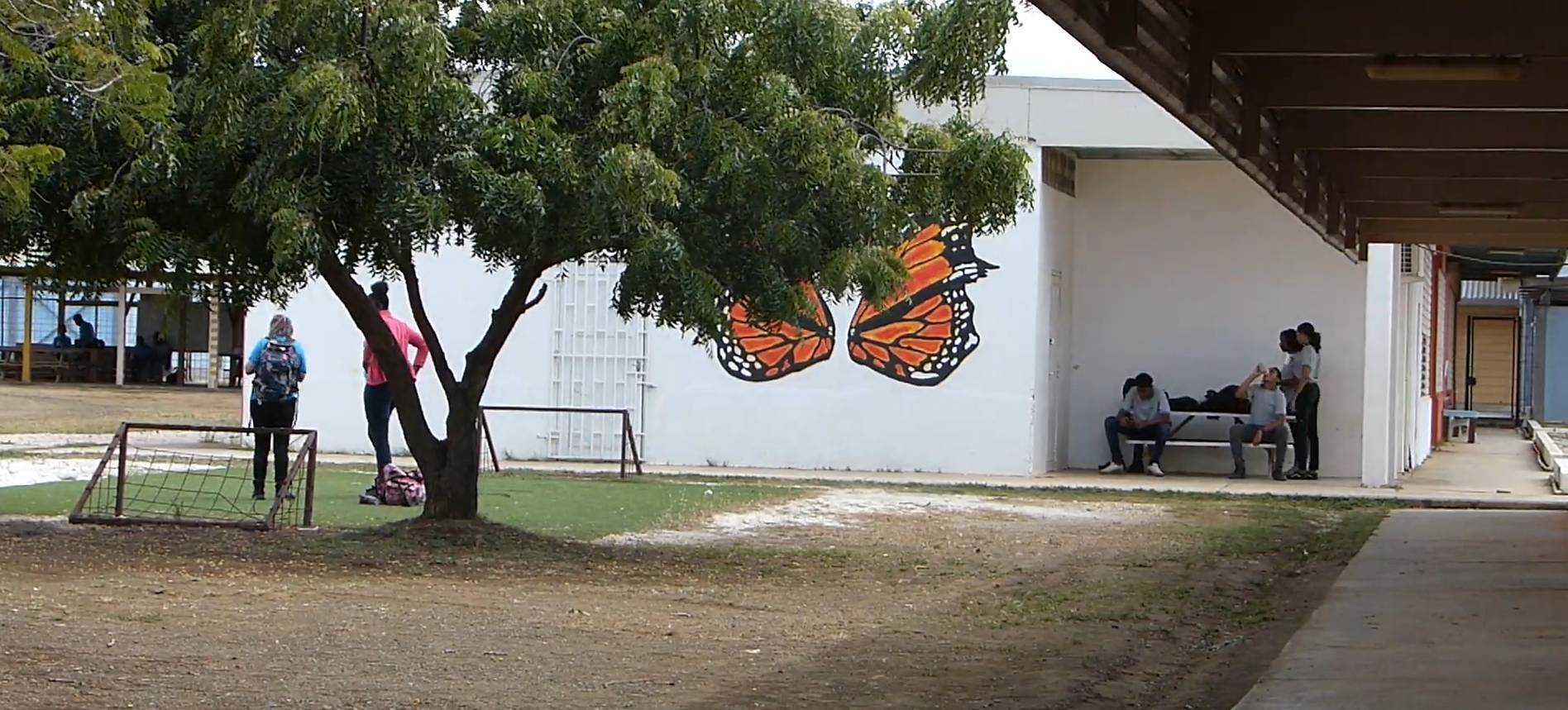
In this first part of a two-article series, Caribbean Network highlights the apparent misunderstanding between politicians in The Hague and those participating in education on Bonaire regarding language proficiency and its function.
The Werkgroep Positie Papiamentu (Work Group Position of Papiamentu) on Bonaire is disappointed with the response from the Dutch Ministries of Education, Culture, and Science (OCW) and Interior and Kingdom Relations (BZK). According to the group, The Hague is still failing to address their concerns in a meaningful way.
Although Papiamentu was officially recognized in 2024 under the European Charter for Regional or Minority Languages – requiring the Netherlands to protect and promote the language – those involved say they see very little of that in practice. “Anyone who speaks only Papiamentu, but struggles with Dutch, is immediately held back by this system,” says chairman and former teacher Sedney Marten.
A place for the mother tongue of most
Last May, the work group, along with the Fundashon Akademia Papiamentu (Papiamentu Academy Foundation), sent a letter to both ministries regarding concerns about the status of Papiamentu in education and proposals for change. “For us, it’s not about the language used for instruction, but about giving the mother tongue, or native language, of most students a proper, full-fledged place in education,” Marten says.
According to the work group, the absence of such a place affects not only learning but also how students feel in the classroom. “One of the primary ways of bullying happens in the classroom, when a child has to give their first presentation in Dutch – a language they don’t feel comfortable in,” says Marten.
‘Main concerns ignored’
An initial response six months later, as well as the most recent one from OCW in February, still hasn’t satisfied the group. “Our main concerns were ignored, and they mostly just repeated things that were already known,” he says.
The Ministry of Education, Culture, and Science (OCW) is not commenting on the criticism. Instead, a spokesperson for OCW Netherlands, Matthijs Holtrop, told Caribbean Network that it is primarily important for the work group to “stay connected to developments around Papiamentu in terms of policy and learning materials.”
Policy and Misconceptions: ‘A Language Deficiency’
During a roundtable discussion in The Hague with Dutch Members of Parliament and experts regarding language in the Caribbean Netherlands, Elsmarie Beukenboom, chair of the Papiamentu Academy Foundation, spoke with an MP about Bonairean students moving to the Netherlands to study. After a short conversation, the MP concluded that they had a “language deficiency” because their Dutch differed from the norm. “A language deficiency? Because we don’t talk like him? This is how we talk,” Beukenboom responds.
According to Beukenboom, this shows a fundamental misunderstanding: any deviation from standard Dutch is quickly seen as a shortcoming. “People don’t look at how well a student masters Papiamentu, English, or Spanish. As soon as the Dutch isn’t perfect, they call it a language deficiency,” Marten adds.
In their view, this way of thinking also influences policy. “When the school says ‘the child is the priority,’ it feels like only the European-Dutch student is the priority,” Marten says. Instead of strengthening the native language, it is the number of Dutch lesson hours that has been increased in recent years. “But without a solid foundation in your native language, learning a foreign or second language actually becomes harder,” he adds.
The idea of a (perceived) “language deficiency” has been a long-standing issue in conversations between politicians in The Hague and the islands. For example, in 2019, former State Secretary Tamara van Ark (VVD) spoke during a visit to Bonaire about a possible early start to mandatory schooling. They explored whether children should start school at age four or even three to get them exposed to Dutch earlier. Those plans weren’t carried out, but they highlighted how strong the focus is on tackling ‘language gaps’ early through investments in preschool and early education.
Beukenboom believes the current laws fall short and, in practice, result in discrimination. “Ignoring the native language costs children opportunities and goes against children’s rights,” she says.
‘Dutch has constantly limited my career’
Mazarella Jansen, a Papiamentu coordinator and teacher at the high school level, noticed early on that her command of Dutch limited her opportunities. “In elementary school, I was good at almost every subject except Dutch. Because of that, I couldn’t go to MAVO (general secondary education) or pursue the educational track I wanted,” she explains. Later, when she worked for the police, Dutch turned out to be an obstacle again. “Because my Dutch wasn’t good enough, I couldn’t become a detective. It was a constant barrier.”
“In my training to be a Papiamentu teacher, I finished everything: I am qualified for both elementary and secondary education and have earned a master’s degree. But if you don’t master Dutch well, you can’t get any further – no matter how good your native language is.” Even now, Jansen notices that Dutch proficiency remains the deciding factor for job applications on Bonaire. “It’s the same for many positions,” she says. “Because my Dutch isn’t at a high level, I can’t become a team lead at the high school, for example.”
According to Marten, her story is typical of what many students and teachers experience. “We are work in a system that is completely upside down. It’s time for all our children to be able to be successful, not just the ones who speak perfect Dutch.” Despite the official recognition of Papiamentu under the charter and promises from The Hague, students and teachers see very little of it in the classroom. Part 2 will go deeper into how this system creates inequality and the specific bottlenecks students and teachers face every day.