The discussion about tourism in Aruba is often reduced to the slogan ‘No More Hotels’. But nowadays, the debate is about much more than just new hotel rooms. In this four-part investigative series, Caribbean Network explores how Aruba grew into one of the most tourist-heavy destinations in the Caribbean, what kind of economic dependence this created, which social impacts are now becoming visible, and which choices lie on the table for the coming years.
Part 4: The fight for space
In the previous part of this series, it became visible how a growing tourism increasingly collides with Aruba’s living environment, nature, and infrastructure. But when is the limit reached?
According to sustainability scientist and environmental activist Nigel Maduro, Aruba has reached that point by now. “We have reached a tipping point where the tourism sector no longer benefits us,” he says. “We are losing the land, the sea, our heritage, and our culture.”
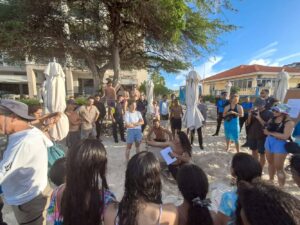
Protests in 2025 near the St. Regis Aruba Resort and Basiruti Beach against the further touristic development of the coast and the increasing pressure on public beach and nature areas. (Melissa Stamper)
Former minister Otmar Oduber (PPA) argues on the contrary that Aruba still has no objective standard for overtourism. Between 2009 and 2016, he was Minister of Tourism and later responsible for Spatial Development, Infrastructure, and Environment. “Where is the study? Where can we find the number?” According to him, the discussion is mostly based on perception.
The discussion is too much about the question of how many tourists Aruba can handle, according to Oduber. “Why shouldn’t we create new beaches?” he asks. He mentions Baby Beach as an example. “If we create thirty percent more beach there, do we still have overtourism? I’m talking about infrastructure.”
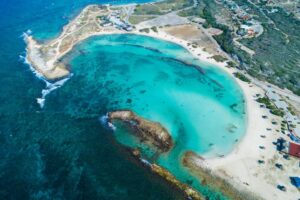
Baby Beach. (Photo: Aruba Tourism Authority)
Former minister Marisol Tromp (MAS) also recalls that tension from various political roles. According to her, her ministerial responsibilities sometimes clashed: from the Environment side, she questioned further hotel growth, while from the Infrastructure side, she had to execute cabinet decisions. She mentions the eventual Ritz-Carlton as an example: she was not in favor of it but found herself responsible for the required infrastructure after the decision was made.
Tromp points to Eagle Beach, where several applications for condo projects (condos you can buy) were filed during her time, including Oceania. The plot where the Embassy Suites now stands also originally had a zoning designation for condo development, according to her. Under subsequent administrations, that zoning was changed to allow for hotel construction.
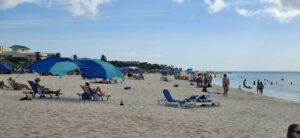
Eagle Beach on a weekday (Melissa Stamper)
What’s Already on the Map
Prime Minister Mike Eman (AVP) voiced concerns about further hotel construction and projects already planned during a public meeting on nature and the environment on July 10. “We are already concerned about what’s on the map,” he said. Eman is willing to engage in the battle over further hotel construction, but acknowledged that doing so in court won’t be easy.
The considerations regarding existing hotel commitments was also on the table back in 2018. At that time, a motion was introduced requesting the government to deliver a cost-benefit analysis of signed commitments for hotel projects. That analysis was meant to weigh those costs against the social impacts of additional staff, including housing, traffic, healthcare, and education. According to the original sponsor of the motion, the requested analysis has still not been submitted to Parliament.
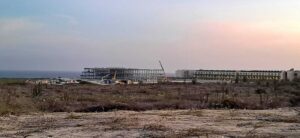
Construction of the second phase of the Secrets Hotel in Seroe Colorado, featuring 300 additional hotel rooms (Photo: Melissa Stamper)
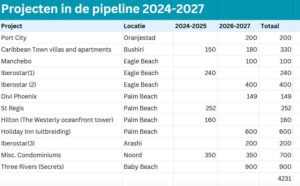
Meanwhile, tourist expansion is not over yet. Development data for 2024 through 2027 includes 4,231 new lodging units, with 3,079 scheduled for 2026 and 2027. Growth is heavily concentrated around Palm Beach, Eagle Beach, and Arashi, but there are new projects planned in Oranjestad and near Baby Beach also. In the meantime, the expansion of the Secrets Hotel is in its second phase.
Tourism expansion is also increasing the pressure on the housing market. According to the 2025 annual report by housing foundation FCCA, more than 3,800 households are waiting for social housing. Moreover, in a separate estimate, FCCA calculates that adding roughly 4,000 hotel rooms to the tourism sector could also bring in about 5,900 additional workers who will need housing as well.
How Aruba uses its available space for residential construction has therefore become part of the debate. Construction engineer Aaron Bislip (Speedy 3D Printing) was involved in the housing development plan for Burubundu, among other projects. He proposed an alternative layout for the available land that combines housing construction with nature conservation. According to Bislip, the plan shows that scarcity is forcing Aruba to change how it builds. “Arubans don’t want to live in multi-story apartments, but now you’re forced to rent an apartment somewhere. That’s what’s currently available, and prices are sky-high.” Several residents interviewed by Caribbean Network also shared how difficult it is to find a rental home. “There are definitely way fewer homes for us Arubans to rent. It’s hard for our own people to find a place to live,” said a resident who asked to remain anonymous.
Public beach, divided space
The struggle for space is also playing out on the beach. Public access to the coast was a founding principle in the original plans for the tourism corridor, but nearly half a century later, it is once again up for debate. For the first time in more than ten years, the government announced a review of the beach policy this year. According to Minister of Tourism, Transport and Labor, Wendrick Cicilia (AVP), this is necessary due to the growth of tourism, changing spatial needs, and the saturation of beaches. “Not a single beach in Aruba will ever belong to a hotel,” he stated.
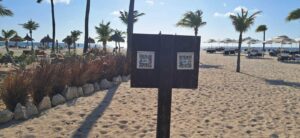
Temporary new 2026 beach guidelines on a QR code at Manchebo Beach (Melissa Stamper)
At the same time, temporary rules were introduced in April for the use of palapas (an open structure with a roof of dried palm leaves supported by wooden poles) and other beach amenities, following a series of incidents on beaches near the tourist zones. Although the beach remains public, hotels are permitted to manage amenities for their guests within designated zones. Under these rules, an assigned palapa can be considered ‘in use’, even when the hotel guest is temporarily not present.
The new guidelines arrive at a time when beach space has already been divided up by previous permits. In a ruling at the end of 2025, the Joint Court of Justice pointed out that large portions of the public beach have already been allocated to hotels through previously granted permits. The Court explicitly highlighted the heavily increased pressure on the beaches of West Aruba.
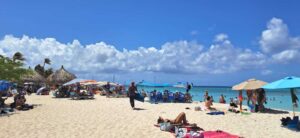
A busy day at Arashi Beach. The available space on the popular beaches along the west coast is coming under increasing pressure. (Melissa Stamper)
Still Growing
That Aruba cannot continue to grow in the same way it has been doing, is something that even the Aruba Tourism Authority (ATA) acknowledges. In response to questions from Caribbean Network, the tourism organization points to the 2018 island carrying capacity study and states that Aruba has reached the limits of the traditional tourism model. While Part 2 of this series already showed that tourism revenues in recent years mainly rose alongside the number of visitors, ATA aims to stabilize the volume and increase the proportion of ‘high-value’ guests: visitors who make a greater economic contribution.
During the Aruba Global Travel Conference in September, ATA director Ronella Croes made that goal more concrete. For 2027, ATA wants to cap the growth in stayover tourists at 1.4 percent, giving priority to visitors who contribute more economically. That still means growth, but at a slower pace.
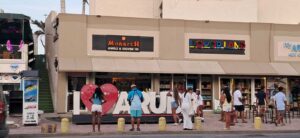
Tourists take a photo with the ‘I love Aruba’ sign in Palm Beach.(Melissa Stamper)
That more tourists do not automatically lead to more prosperity per inhabitant is also evident from research by economist Arjen Alberts. In his 2020 dissertation, he shows that for years the economy grew primarily through the expansion of tourism volume, while average productivity stagnated. Alberts sees a paradox: the growth model can generate economic progress for individual groups, keeping further expansion attractive even as the island’s limits come into view.
For now, the tourism volume continues to increase. Figures up to August show faster growth for the time being. In the first eight months of 2026, the number of stayover tourists was 11.1 percent higher than in the same period a year earlier. At the same time, the airport is being expanded with additional gates and larger waiting areas. According to the Aruba Airport Authority (AAA), this is intended to increase capacity at a time when travel demand to Aruba remains high.
Asked by Caribbean Network about how ATA measures the shift toward higher economic value with less strain on the island (‘High Value, Low Impact’), the organization refers to metrics including tourism revenues, credit card spending, visitor satisfaction, and surveys among departing visitors. These provide insight into spending and experiences, but make it less clear how the pressure on the island is being measured.
In her September speech, Croes says that ATA also monitors broader indicators for quality of life and the protection of nature and culture. However, she does not clarify in the speech which benchmarks are used to determine whether visitors are factually causing less strain.
Setting boundaries
The Aruba Hotel and Tourism Association (AHATA) also advocates for further-reaching measures in response to questions from Caribbean Network. Where ATA aims to slow growth, the hotel association wants the number of visitors to stop increasing. Among other things, AHATA is calling for a daily cap on flights and cruise passengers, as well as restrictions on new hotels and condominium projects. According to the organization, the government should negotiate with developers regarding projects for which permits have already been issued.
The government recently announced a new course. Under the responsibility of Minister Cicilia, a working document has been drafted featuring twelve programs for the period from 2027 to 2031, including proposals for a different approach to tourist accommodations and the protection of nature and the living environment. The document has not yet been finalized. Which concrete limits to further tourism development will be placed, is yet unclear.
Spatial policy is also being revised. Minister René Herdé (AVP) tells Caribbean Network that the existing Spatial Development Plan with Regulations (ROPV, Ruimtelijk Ontwikkelingsplan met Voorschriften) has been extended because preparations for a revision were not started on time. The intention is to revise the ROPV together with the Spatial Development Plan (ROP), which expires in 2029. Herdé is looking into doing this sooner.
According to him, the housing shortage in particular makes this revision urgent. “Not just the expansion of tourism, but the greatest challenge in my view is the need for housing. The massive need for housing,” he says. The Department of Infrastructure and Planning (DIP) has been commissioned to locate land for housing construction within the current ROPV.
Meanwhile, development continues and part of the space is already locked in through existing designations, permits, and projects. For activist Maduro, the question of where the limit lies ultimately comes down to who will have any space left. “Indirectly, we are being displaced from our own heritage,” he says. “We are being pushed away from the places we used to visit all the time. Bit by bit, those spaces are being privatized.”
This publication has been realized with the support of the Fund for Special Journalistic Projects.