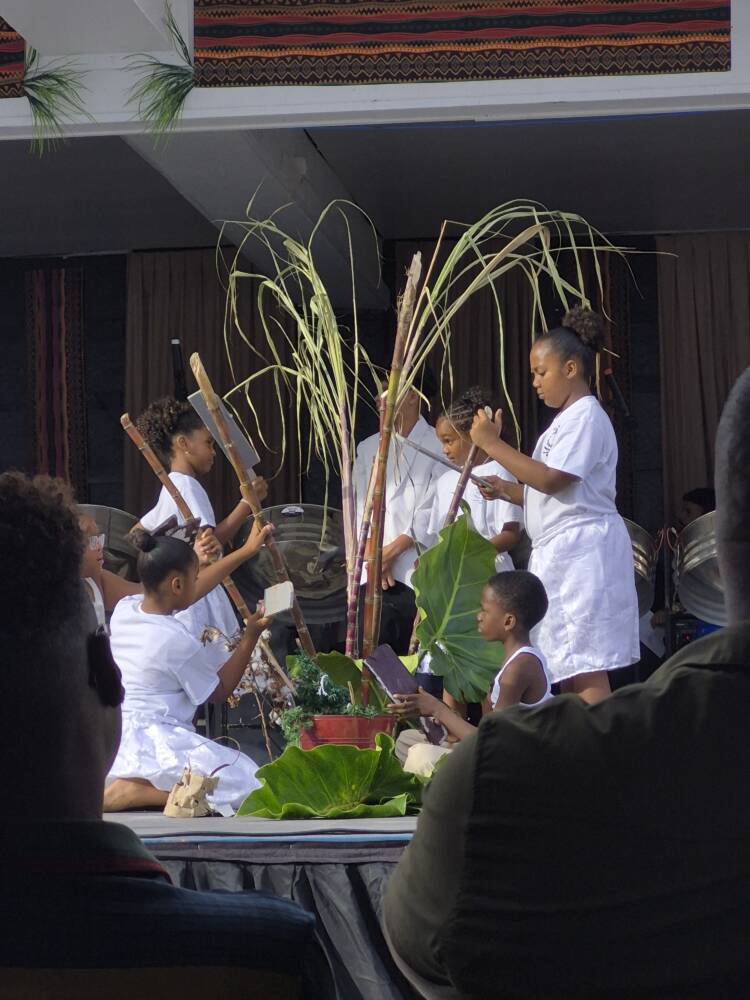
Saba marked the 163rd anniversary of the abolition of slavery in the Dutch Caribbean during its 2026 Emancipation Day Commemoration on Wednesday, July 1st, 2026, featuring keynote speaker Mutabaruka and a program of cultural performances.
Master of Ceremonies for the afternoon event, Vito Charles, Board Member of the Saba Heritage Center, said the ceremony served as a reminder that Emancipation Day is not only a time to reflect on the past, but also an opportunity to acknowledge the enduring legacy of slavery, honor those whose freedom was denied for so long, and ensure that their stories are never forgotten.
July 1 official holiday on Saba as of 2027
This year’s observance carried added significance as it is the final Emancipation Day before July 1 officially becomes a public holiday on Saba in 2027. With Saba joining Sint Eustatius and Sint Maarten, all three Windward Islands will officially recognize the day as a public holiday. Charles shared that Aruba also plans to designate Emancipation Day as a public holiday, beginning next year, reflecting growing recognition of the occasion across the Kingdom.
Charles credited the milestone to years of collaboration involving the Island Council, the Ministry of Social Affairs and Employment, community organizations, schools, the business sector, and residents who advocated for official recognition.
Remembrance must lead to meaningful progress
Newly appointed Island Governor Jocelyn Levenstone delivered his first public address during the commemoration, calling the occasion a fitting beginning to his tenure and urging the community to continue building on the promise of emancipation. He described Emancipation Day as one that “asks us not only to remember, but to reckon honestly with where we have come from.”
Levenstone praised the efforts that led to Emancipation Day being recognized as a public holiday, acknowledging the sacrifices of those who advocated for its official recognition, and also paid tribute to the Slavery Memorial Committee for its work in researching and documenting Saba’s slavery history. “The committee has helped restore the identities of people who had long been reduced to names in historical records.”
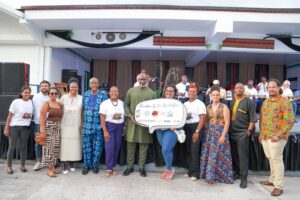
New Island Governor Jocelyn Levenstone pictured with members of contributing foundations to the commemoration. Photo Lincoln Charles
He emphasized the importance of remembering the island’s full history, noting that Saba’s families include descendants of both enslaved people and slave-owning families, sharing that his own family traces its roots to those who were enslaved.
Dignity, respect, and constitutional governance
Levenstone thanked outgoing Governor Jonathan Johnson for his 18 years of service, describing the peaceful transition of leadership as an example of the promise of emancipation being fulfilled through dignity, respect, and constitutional governance. Referring to the Dutch government’s 2023 apology for its role in slavery, he said the apology should be viewed as “a comma, not a full stop,” stressing that remembrance must lead to meaningful progress rather than end with symbolic gestures.
He called for slavery history to be fully integrated into education, for the work of the Slavery Memorial Committee to be preserved, and for efforts to reduce inequality through measurable action.
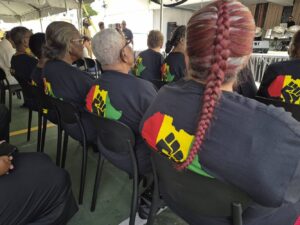
Saba Life Center participants sporting their Emancipation Day t-shirts. Foto Hazel Durand
‘Remember the ordinary men and women’
Secretary of the Slavery Past Memorial Committee Foundation Dimetri Whitfield, in his address urged the community to remember the ordinary men and women whose labor and sacrifices helped build Saba. “They were free people before they were enslaved and their descendants owe their existence to their perseverance,” he emphasized. He noted that enslaved people were often remembered only through records of their sale or punishment, while their humanity, resilience, and contributions went unrecorded.
He shared a childhood conversation he had with his grandmother about their family’s ancestry, recalling how their family history could only be traced back to Louisa, an enslaved woman born on Saba who gained her freedom in 1863. He said the inability to identify Louisa’s parents illustrated the painful reality that slavery erased the identities and histories of countless enslaved people. “Commemorations such as Emancipation Day ensure the stories of those once forgotten, continue to be remembered by future generations,” Whitfield concluded.
Emancipation requires reconnecting with African cultural roots
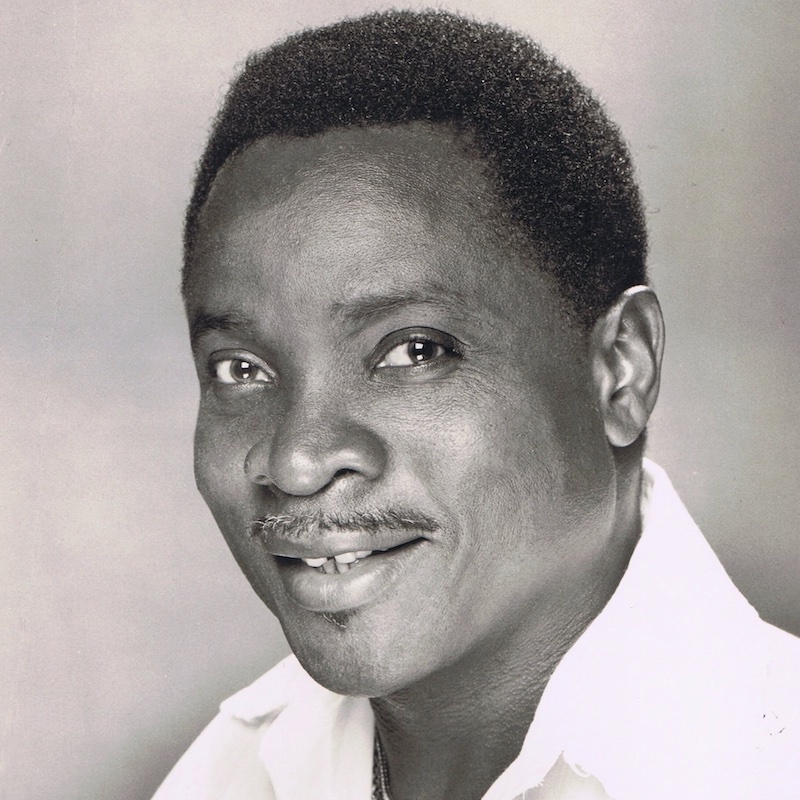
The keynote speaker for the ceremony was Mutabaruka, Jamaican Rastafari dub poet, musician, actor, educator, and talk-show host, who delivered a thought-provoking address on the importance of understanding who we are and where we come from, as the foundation for defining our culture and identity.
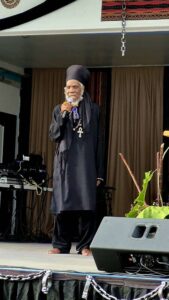
Mutabaruka. Photo Hazel Durand
Mutabaruka said the legacy of slavery extends beyond physical bondage to a form of mental slavery that continues to shape Black identity and culture. He said true emancipation requires freeing the mind from colonial influences by reconnecting with African cultural roots and understanding the beliefs and traditions that existed before the transatlantic slave trade.
He also contended that colonial education and religion fostered feelings of inferiority among Black people, emphasizing that reclaiming and passing on African culture to future generations is essential to achieving genuine freedom.
AI digital age and its influence on identity
Mutabaruka also warned about the growing influence of smartphones, social media, and artificial intelligence on young people, arguing that technology is increasingly shaping how they think and interact with the world.
He expressed concern that many children have become overly dependent on their devices for information and entertainment, while spending less time learning about their own history and culture.
He urged parents to take a more active role in guiding their children’s use of technology and stressed that cultural education must keep pace with the digital age to prevent further erosion of identity.
As part of this year’s activities, workshops on traditional medicine, corn pudding, and cassava bread were held to preserve cultural practices linked to the knowledge and resilience of African ancestors. Organizers said passing these traditions on to younger generations helps keep an important part of Saba’s heritage alive.