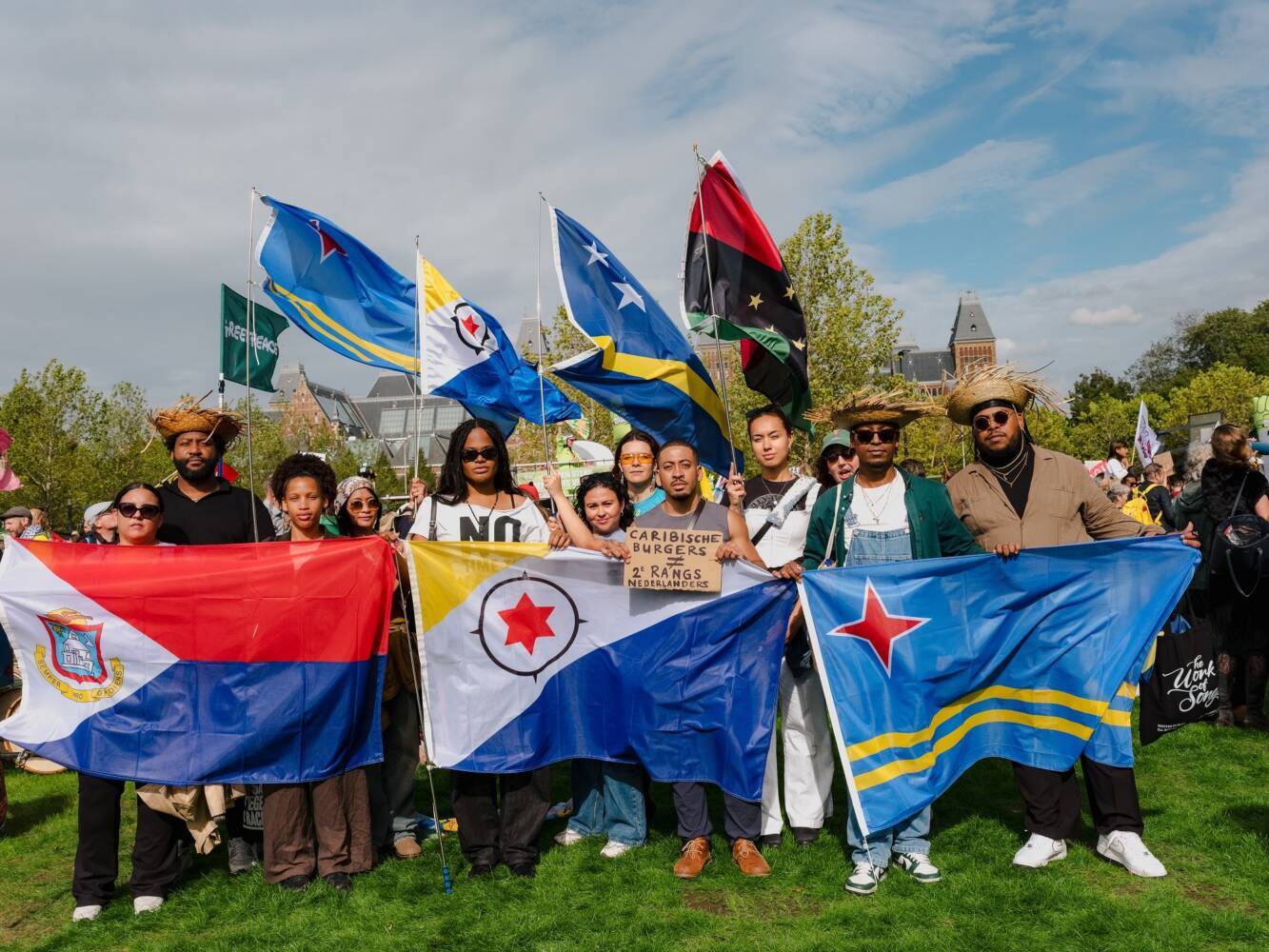
More than 40,000 people walked from the Dam to Museumplein in Amsterdam on Saturday, September 12 for the national Climate March, three days before Prinsjesdag. The organization talks about approximately forty thousand participants, distributed across 43 thematic blocks. One of them stood out: the Caribbean block with the flags of the islands.
For these youth it is clear that the burden of climate change and who decides on it are very far apart. The islands most affected by climate change have the least to say about the policy that should protect them. That’s why they also marched: to jointly give a visible message to the Dutch government to protect the climate.
Hardest blow
That the Caribbean block was there is partly thanks to the work of Churmer Bomba, Bonairean and community organizer at Greenpeace Netherlands and co-organizer of the block. In that capacity he also speaks on behalf of the organization. “It shouldn’t matter whether you live on Ameland or Bonaire: everyone wants safety and a future for their children,” he says. “Our cabinet must protect all citizens against the climate crisis and stop double standards.”
Greenpeace facilitated the block, precisely because the Netherlands doesn’t stop at the European border, and fellow citizens in the Caribbean part of the kingdom thus fade out of view. They hardly contributed to the climate crisis, but they are already getting the hardest hits: extreme weather, drought, failed harvests and a rising sea level. With this block the organization demands that the government address that inequality, and give the most vulnerable islands the protection they deserve.
For Bomba this is not an abstract file. “My sister on Bonaire doesn’t receive the same protection that I receive in The Hague,” he indicates. “Why may I enjoy a higher degree of protection against the climate crisis, purely based on where I live?” And: “I don’t want to live in a world where we have to import crops for the simadan and seu harvest festivals, because due to heat and drought, we no longer harvest our own.”
Climate Case
For Kjelld Kroon, one of the eight claimants in the Bonaire Climate Case (Klimaatzaak Bonaire), the march is more than a signal. “It is important for us as Caribbean Dutch people and at the same time one of the claimants in the Climate Case, to participate and make ourselves visible also in this struggle and climate movement, which is primarily white in the Netherlands,” he says.
On January 28, 2026, the court in The Hague judged that the climate policy of the Dutch state violates the human rights of the inhabitants of Bonaire by treating them unequally compared to European Dutch people. Within eighteen months the state must set new climate goals. The right to culture – from threatened historic slave houses to a way of life that matches the country – was also included in the verdict.
‘Bonaire is left to fend for itself’
Kroon lives with one foot in Amsterdam and one in Bonaire, and already sees the consequences: intense heat, drought, a rising sea level and water nuisance. “Bonaire is left to fend for itself,” he previously told Trouw. The verdict gives the injustice that Caribbean Dutch youth feel a legal basis, but with that it is not policy yet.
Glenpherd Martinus marched alongside him, Dutch citizen from the Caribbean diaspora. He finds that there is still less urgency for the islands, and therefore less attention and fewer means to combat climate change compared to the Netherlands.
“Of course the Netherlands is known for water management, they are pioneers in that, and apply that knowledge worldwide too. That is why it is actually incomprehensible and of course unacceptable that they abandon their own compatriots,” he says.
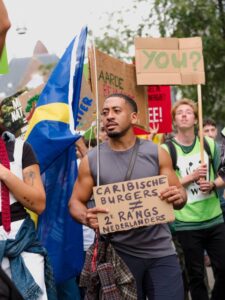
Glenpherd Martinus. Photo Tengbeh Kamara / Greenpeace
The appeal that the cabinet is making against the verdict in the Climate Case, he sees as a conscious choice. “To act subversively against the law, but also to emit their message that actually the Caribbean part of the kingdom is negligible and insignificant, and that we are second-class citizens.”
Hope for Prinsjesdag
On Prinsjesdag, September 15, the cabinet presented the budget for 2027, and in this there are two files for the Caribbean part of the kingdom that are directly of importance.
First, the distribution of the 30 million euros promised for existence security on Bonaire, Sint Eustatius and Saba, of which it is already set that 7.5 million will go to the Caribbean Netherlands Nature and Environment Management Plan – the climate adaptation fund for the islands.
Second, whether there is still money for the Temporary Work Organization (TWO, Tijdelijke Werkorganisatie) and with that for a continuation of the national packages with Aruba, Curaçao and Sint Maarten. As could be read previously in this file: climate justice is also a budgetary matter. Adaptation on the islands depends on money distributed in the same budget, and time is pressing, because the Climate Case verdict leaves little room for another round of postponement.
Greenpeace wants execution of verdict
Greenpeace too followed Tuesday’s events with that urgency. “Stop stalling,” Bomba says, who voices the position of the organization. Greenpeace wants the cabinet to finally execute the judge’s verdict in the Bonaire Climate Case directly and fairly. At the beginning of the year the court sentenced in clear words that the state is violating human rights and is discriminating against inhabitants of Bonaire with deficient climate protection.
While it was a summer with heat records, excess mortality, and coral disappearance, the cabinet remains remarkably quiet and even chooses legal procedures to paralyze the execution of the verdict.
Therefore, for Prinsjesdag, Greenpeace demands concrete action: from the Climate and Energy Exploration it will probably result again, that the Netherlands does not reach its own climate goals, and that is why the cabinet must offer clarity and honesty about the space the Netherlands still has to emit CO2, and work immediately on fair and binding reduction goals for all sectors.
Kroon hopes the cabinet respects the verdict in the Climate Case, and will make new calculations of the Netherlands’ CO2 emissions, including Schiphol and the port of Rotterdam. “It’s about simply having an integral and realistic plan that takes our climate into account too. But knowing our prime minister, of course you can be sure he won’t do that.” Martinus hopes for money from the state treasury. “It’s about investing means and stating explicitly that attention is also given to the Caribbean part of our kingdom. But my expectation is that this won’t be discussed at all, or that no sum of money will be connected to any means at all, for fighting climate change on the islands.”
Message for the Netherlands
That must include a message for The Hague and the rest of the Netherlands too. For the government: stop discriminating against Caribbean Dutch people and treating them as second-class citizens. “We deserve the same protection as the Netherlands,” Kroon says. “Twenty years ago, already. So, they’re running late.”
His appeal is concrete: stop postponing climate management, execute what the verdict in the Bonaire Climate Case instructs, and stop the appeal. Martinus asks the cabinet to take responsibility and fulfill the promises with which it won votes. “Caribbean Dutch people are not second-class citizens. At least don’t oppose the existential struggle we are waging, but be supportive, a partner for us.”
To everyone in the Netherlands who votes or makes choices: be aware that the Netherlands also governs Caribbean territories. “Think too: what is the impact on my Caribbean brothers and sisters?”, Kroon says. Martinus appeals to come into action, sign petitions, protest side by side, and use your vote when choosing who comes into that power position. It is the same question asked on the Dam, but now directed directly at the cabinet members who presented the budget on Tuesday.