In January, four tourists drowned at different locations in the sea around Aruba. Not much information has been released to the public about the causes of these incidents. One thing is certain according to Marla Dominguez, a lifeguard instructor at the Red Cross: the outcome could have been different if lifeguards had been on-site.
In the 1970s and early 1980s, the Red Cross provided rescue services on Aruba. Dominguez reminisces: “We had a boat, a pick-up truck, an ambulance, and lifeguards at Eagle Beach.” During that period, the Red Cross relied on donations and did not receive any subsidies from the government. “Because of that, it became too expensive; we could not sustain it.” Since then, the tourist island has not had any lifeguards.
No Accountability
Besides the financial reasons, Dominguez says the issue is likely also about accountability. “Nobody wants to take responsibility for lifeguards on the island, nor for the safety of the bathers. If you are a lifeguard and someone drowns under your watch, they can say: ‘You work there and you did nothing about it, so it is your fault that someone died.’”
Photo: Petra Trindad
Dominguez sees this happening at the hotels as well. There are no lifeguards at the swimming pools; instead, there are signs that say: “Swimming at your own risk.”
Lifeguards
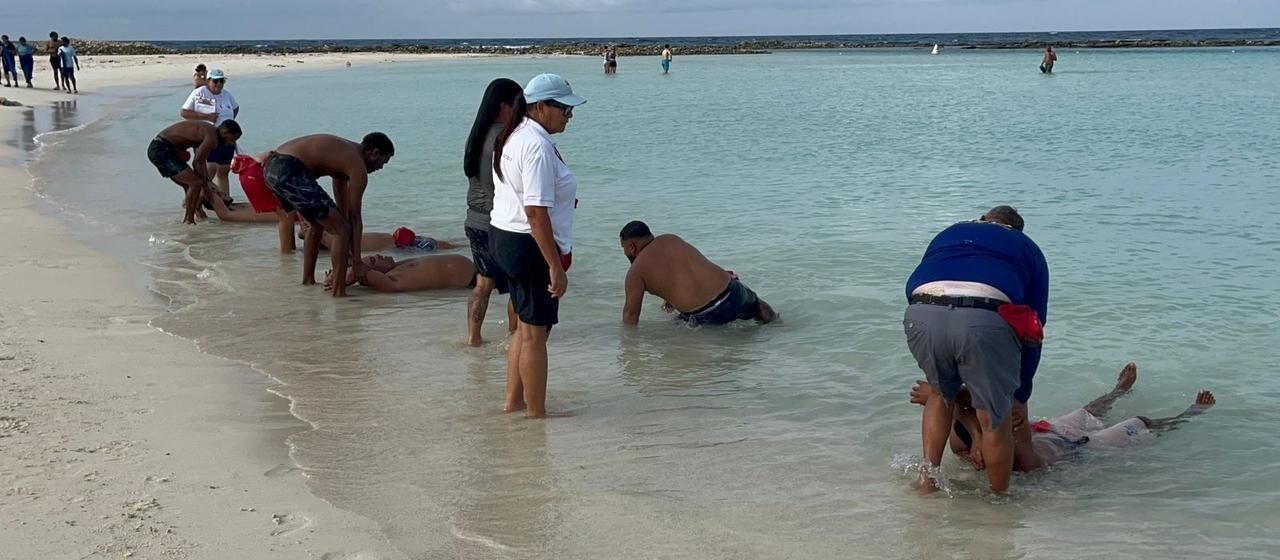
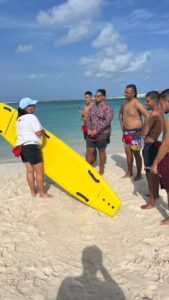
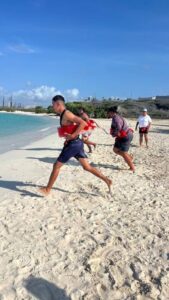
After the incidents in January, the debate has flared up again about whether there should be lifeguards on the island. According to Dominguez, the survival chances of the drowned tourists would likely have been greater if lifeguards had been there. The instructor explains that as a lifeguard, you learn to monitor the people in the water: “You count how many people are in the water, and if one is missing, you take action immediately.” Also, a lifeguard arrives at the scene sooner and can therefore start first aid immediately until the ambulance arrives.
Photos: Marla Dominguez
Dominguez has now worked as a lifeguard instructor for fifteen years. Even so, she is not frustrated about the situation on the island. Through the Red Cross, she trains students every year, such as people who work as instructors for school swimming, individuals who go out to sea with tourists, and people who work privately as lifeguards at beach parties. Every year she gives three courses, with an average of eighteen participants per course. “There are even police officers who follow a lifeguard course in their own time,” she says.
Motion from Member of Parliament
Following the drowning incidents, Jennifer Arends-Reyes, a Member of Parliament for the AVP party, asked questions at the end of January to the Minister of Tourism, Transport, and Labor, Wendrick Cicilia (AVP), about safety at sea. “For me, it is first and foremost about human lives. Every drowning is a tragedy for families and for our community. Additionally, Aruba is an island known worldwide for its beautiful beaches. It is therefore our responsibility to ensure that people can not only enjoy the sea here, but that they can do so as safely as possible.”
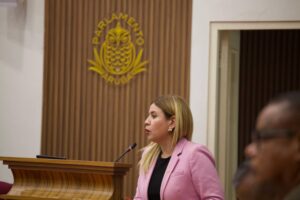
Photo: Jennifer Arends-Reyes
According to Arends-Reyes, safety at sea is seen in practice as a shared responsibility. She says: “Swimmers obviously carry their own responsibility, and hotels often take safety measures for their guests on the beaches in front of their resorts.” However, she states that the government has an important role regarding public safety, regulations, and supervision. “That is exactly why it is important to have more clarity on who carries which responsibility, and how these can be better coordinated with each other.”
Central Data System
Another point she wants clarity on from the Minister is the lack of a central system where data is kept regarding drowning incidents on the island. According to her, such a central system is likely missing right now because data is scattered across different agencies, such as the police, hospitals, or emergency services. Because of this, it is difficult to assess risks and take preventive measures.
The Member of Parliament says it is currently difficult to estimate how large this investment will eventually be; that depends, among other things, on how many beaches will be provided with lifeguards, what training is needed, and what infrastructure will be set up.
Since December, Dominguez too has been in talks with Minister Cicilia. She says that she has had good conversations with the Red Cross and that several ideas are already on the table – including the locations where the lifeguard stations should be placed.
At Least Four
According to her, there should be at least four stations on Aruba: at Arashi, Eagle Beach, Spaans Lagoen, and Baby Beach. Dominguez hopes to speak with the Minister again soon to make the plans more concrete. “We can train the lifeguards with the Red Cross, but the government must hire the people and provide the equipment and the funding.”