The discussion about tourism in Aruba is often reduced to the slogan ‘No More Hotels’. But nowadays, the debate is about much more than just new hotel rooms. In this four-part investigative series, Caribbean Network explores how Aruba grew into one of the most tourist-heavy destinations in the Caribbean, what kind of economic dependence this created, which social impacts are now becoming visible, and which choices lie on the table for the coming years.
Part 3: The price of ‘One Happy Island’
“We never know who our neighbors are anymore, because they change every few days.” For Edeline Berg, her neighborhood in Paradera has changed dramatically in recent years. Across from her home, two houses are rented out exclusively to tourists.
It is not only neighborhoods that are changing because of the growth of tourism. On the north coast, bodyboarder Rodney Tromp has been coming to Andicuri for over thirty years, a beach that according to him used to be visited mostly by Arubans. Nowadays, dozens of Utility Task Vehicles (UTVs, a type of off-road motor vehicles – ed.) drive along the coast every day, and more and more organized tours stop there. “It’s not local anymore,” he says.
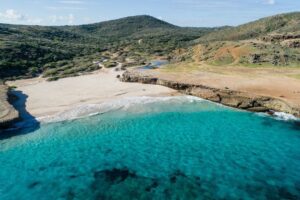
Andicuri (Photo: Aruba Tourism Authority)
In the previous part of this series, the economic importance of tourism was central. But while tourism kept growing, warnings were also given about the limits of that growth. Already in 2018, the Carrying Capacity Study by the Aruba Tourism Authority (ATA) concluded that Aruba was reaching the limits of its carrying capacity. In response to questions from Caribbean Network, ATA states that this study still gives direction to its policy. Still, the number of visitors kept growing. Eight years later, the consequences of that growth are visible in various places across the island: in residential neighborhoods, nature areas, and along the coast.
Berg says that for years Paradera was a quiet residential neighborhood, where neighbors knew each other and looked out for one another. That changed when two houses were built across from her home that are rented out exclusively to tourists. The owner does not live on Aruba. Ever since, she says, the nights are regularly disturbed by loud music, pool parties, screaming, arguments, and visits from the police.
Berg is not the only one. Speaking with Caribbean Network, other residents too mention increasing traffic, parking problems, and noise nuisance, as well as homes making way for vacation rentals or tourism businesses.
Vacation rentals are no longer limited to the traditional tourist areas around Palm Beach and Eagle Beach. An analysis by Caribbean Network, based on public Airbnb listings, shows that vacation rentals have now spread across almost the entire island, including neighborhoods like Paradera.
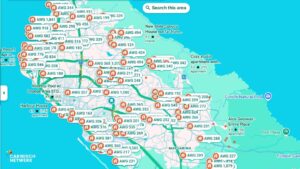
The number of ‘vacation rentals’ that are publicly listed on Google Maps.
The growth outside the traditional hotel sector is also visible in the official figures from the ATA. In the first half of 2026, 41.5 percent of all overnight stays took place in the ‘Others’ category, which includes vacation homes and apartments. That made this category larger than hotels, all-inclusive resorts, and timeshares individually.
The spread of tourism is not limited to vacation rentals in residential neighborhoods. In Pos Chiquito, ecologist Oriana Wouters sees how Mangel Halto has changed as well. When she returned to Aruba in 2018, she noticed that the place where she grew up and learned to snorkel had by then grown into a popular tourist destination. Mangel Halto is included in the ATA’s ‘bucket list’ for visitors in a tourist brochure. “On the weekend, tour buses and UTVs drive through the neighborhood continuously. When I’m outside, people look straight into my yard from a safari truck,” she says.
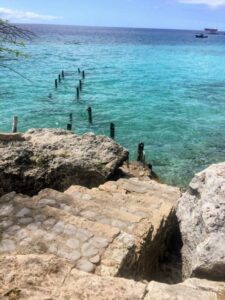
Mangel Halto (Photo: Melissa Stamper)
Wouters points out that anyone who only looks at the crystal-blue water, does not see what is happening beneath the surface. The seagrass beds where she used to snorkel have, according to her, disappeared in some places.
There is also research showing that nature around Aruba is under pressure. A baseline study from 2019 by environmental and nature organization Carmabi on the condition of the coral reefs, seagrass beds, and mangroves around Aruba concluded that these ecosystems have been declining for a long time. Across seventeen studied reefs along the southwest coast, average coral cover had decreased by about 60 percent since the late 1980s: from 22.2 to 8.8 percent.
That decline does not have one sole cause. Carmabi points among other things to pollution from land, wastewater, overfishing, and other human pressure. Climate change increases that pressure through the warming of seawater and coral bleaching. In 2023, ‘code black’ was declared for Aruban coral, when severe bleaching and Stony Coral Tissue Loss Disease came on top of the existing pressure on the reef.
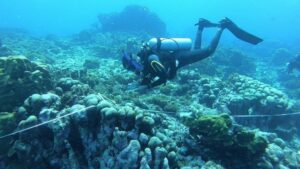
Corals on Aruba were examined at around 10 meters depth in 2023 (Photo: Aruba Conservation Foundation)
Residents around Malmok and Tres Trapi too notice the pressure of tours. Tony van Veen, who lives in the area, says he sees more than a hundred UTVs drive past on a regular day. Farina van Veen counted about twenty tour buses along the north coast on a day when two cruise ships were docked in the port. At Tres Trapi, Tony sees what that pressure means in reality. According to him, the small bay is suitable for about ten people, but he has seen groups of more than fifty people from UTV tours arrive there.

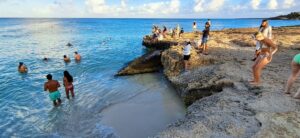
UTV tours and the crowds at Tres Trapi (Photo: Melissa Stamper)
The pressure from tours also affects the quality of life in residential neighborhoods. Since the closing of the route to Andicuri, almost all UTV and ATV tours drive through Sabanilla Abou. For resident Tyson Lopez, that has become part of daily life. “The discussion is often about nature, but for us it is also about the quality of life,” he says.
Lopez indicates that the dust from the vehicles forces him to keep his house closed, use allergy medication, and clean his home twice a week. Residents already wrote a letter to the government three years ago, but according to him, little has changed. Eventually, they put up signs along the road themselves.
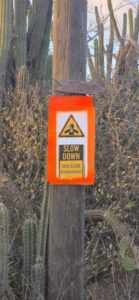
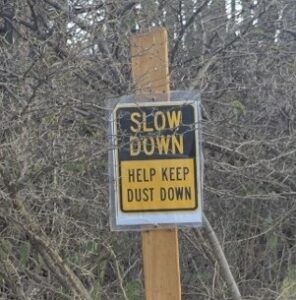
Stop signs in Sabanilla Abou (Photo: Tyson Lopez)
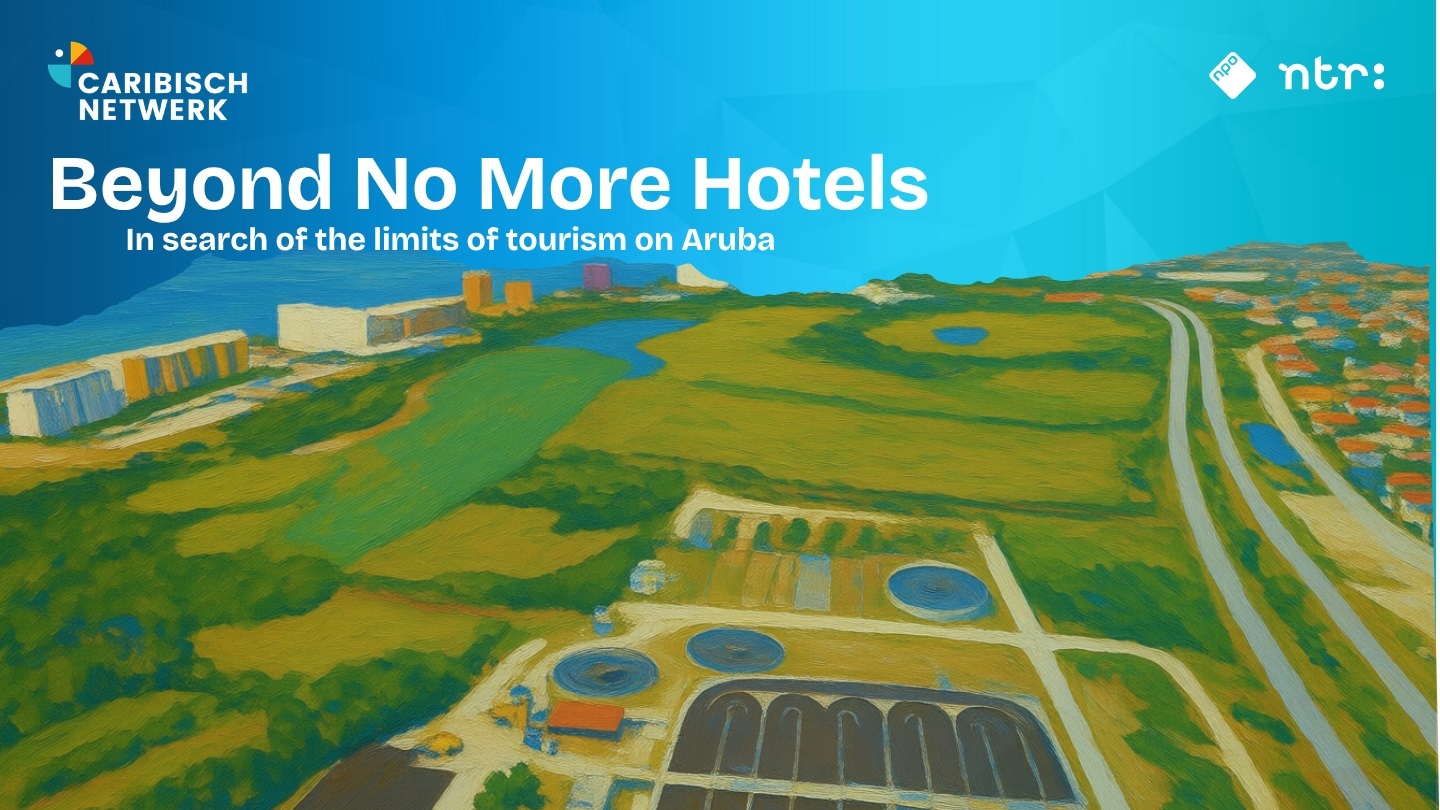
It’s not only on residential neighborhoods and nature areas that the growth of tourism puts pressure, but also on the facilities that have to absorb this growth. Research by TNO in 2018 shows that the rapid growth of the population and tourism caused the facility to exceed its maximum hydraulic and biological capacity.
In the government plan Waste Management Approach 2022–2025, the increasing load on the facility is also directly linked to the growth of the tourism industry around Eagle Beach and Palm Beach. The RWZI (Wastewater Treatment Plant) was designed for about 4,500 cubic meters of wastewater per day. The facility processed between 8,500 and 12,000 cubic meters per day in 2022, depending on rainfall and the tourist season.
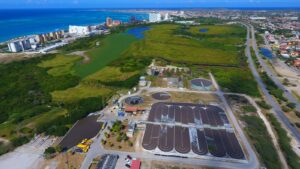
RWZI facility (Photo: Public Works Department Aruba)
The problem with capacity is something that also waste management is dealing with. In 2017, TNO warned that the landfill at Parkietenbos would only last a few more years if policy remained unchanged.
Former Minister of Nature Ursell Arends (Raiz) links those capacity problems to tourism development: “We kept developing hotels without letting the facilities grow alongside them. Developing without planning is a disastrous formula.”
The question is therefore how much space Aruba still has for further tourism growth. In the fourth and final part of this series, the fight for that space takes center stage and we look at the choices that still lie ahead for Aruba.
This publication was realized with support from the Fund for Special Journalistic Projects.